4. Complexity in election
5. Elements other than policies
4. Complexity in election
Complexity in election needs to be taken into account. Although people choose representatives in representative democracy, it doesn’t mean that they completely agree with all of the opinions which the representatives they chose have. For example, hypothetically in terms of social care, a person vote a representative which has clear manifesto in that domain, but the voter doesn’t agree with the representative’s economic policies. However, in the current representative democracy, citizens have to choose representatives as if they agree with all policies the ones they chose propose, and when elected the politicians try to proceed their policies.
Chart 1 is a chart of a representative’s policies. There are areas named Economy, Diplomacy, Social care, Immigration, and Others and the size of each area depends on how much emphasized, for example as it can be seen, the candidate focuses more on social care than economy. They are policies explained by the politician. Since those who are elected are voted by huge number of voters, even if some voters choose a candidate because they support only the politician’s economic policy and social care in chart 1, other voters choose the same politician because of immigration and diplomatic policies, this is very simply saying. The domains some prefer are not supported by others although they both voted for the same politician, in this case given votes concentrate in the elected, even if there are policies the voters don’t agree with, some people might say the representative democracy works as it is conducted right now.
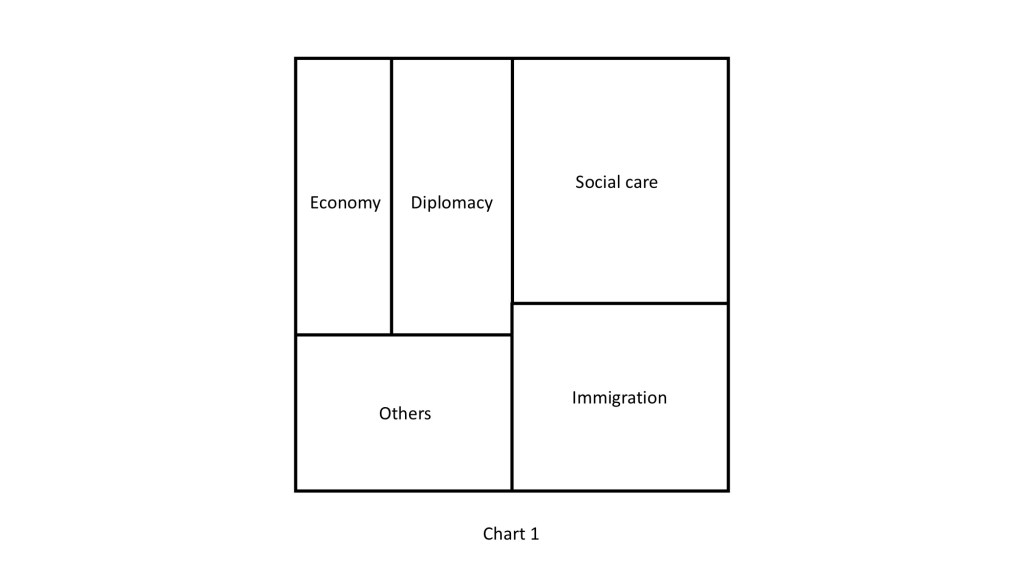
In the same sense, voters who support the same candidate possibly may agree with different domain of policy means that in the policies of the candidate, there can be areas some voters support which are not supported by others who voted for the same politician. After gaining influence by winning election, the representative would move forward the policies promised during election campaign, but hypothetically it is likely to happen that some of the policies are achieved, but others are not. If there are huge supporters who chose the representative because of non-achieved policies, I think there should be other ways to reflect their opinions — one idea I can think of is having sort of direct-democracy.
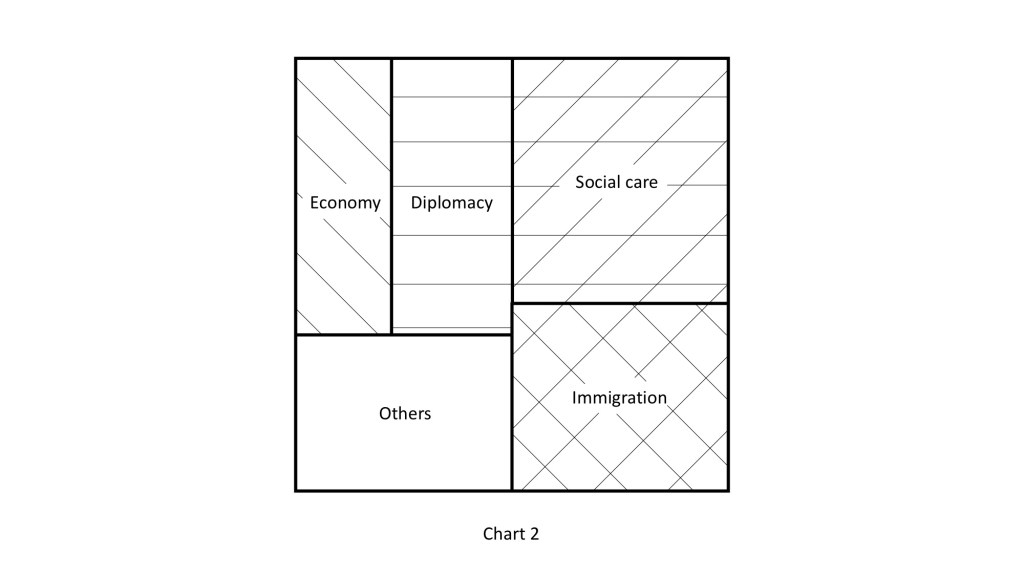
Chart 2 hypothetically assume the situation that a group of people voted the person because of the social care and immigration policies, another group agreed with the economic and immigration policies, and there is third group in favor of diplomatic and social care policies. As it shows that social care overlapped by the first and third group of voters and immigration policy supported by the first and second groups are more supported than diplomacy and economy. From this chart, there is a opinion gap (or policy gap) among them, what can be seen are between those who support social care and people of economic policy. Those people supporting social care don’t agree with economic policy, among them there are certain people of not supporting diplomatic policies (who are people of first group) and people from third group not in support of immigration and economic policies, if elected the representative will basically try to move all these policies forward.
5. Elements other than policies
People choose representatives not just because of their policies. People are influenced by candidates’ personalities or other factors such as leadership — those factors are placed within the category Others in the case above in order to simplify, however I rather think that it might be more proper to build a chart that the those elements including leadership, popularity, and other elements cover the chart entirely as people first come to know candidates by their influence and then may dive into their specific policies, in this case the chart could be drawn as a sphere whose surface corresponds to elements other than policies and the cross-section is divided into specific political domains a candidate present. In the elements, factors such as impression, leadership, negotiation skill, powerfulness of each candidate are included. Impression — not just the first one, but also continuous impression which can suddenly plummet by a scandal or misphrased remark or can be augmented by positive remark — and momentum — which has to do with collectivity of impression as well — of candidate have impact on flow of voters. These elements have more impact on the electorate than the actual policies.
If we move to direct democracy in the future — as of right now, I don’t think it’s possible to function well —, leadership and negotiation are more important factors among representatives than now — assuming that the choices of citizenry are more reflected, though it depends on to what extent the society moves to direct democracy, the authority to choose the direction the state will take is assigned more to its citizens. Even if decision-making becomes what citizens can more participate in meaning that the number of congresspersons is minimized. In order to move things forward domestically and internationally by the leadership and negotiation skill of representatives, we need representatives. Additionally, I think it’s not so realistic for citizens to play most of roles in policy and decision makings.
Assuming that vast number of citizens have the same opinion on a direction of a state it is not necessarily a right choice as decision by those in power is also not necessarily right — apart from rightness I think there are at least many decisions which are not just due to majority rule that becomes law or other establishments, if think about justice John Rawls wrote in A theory of justice: “justice denies that the loss of freedom for some is made right by a greater good shared by others. It does not allow that the sacrifices imposed on a few are outweighed by the larger sum of advantages enjoyed by many”[7.2]. Rightness and justice are key to be considered, but at least for the direct democracy comes top of the current indirect democracy, I suppose here that there would be possibility of bringing about right choices (or aspects) as the wrong would arise, to reflect the public opinion given the current politics in more democratic countries might not work — I think having a system to do it has benefits in a sense that if the system is made to deal with the cases such as abuse of power of representatives or the very decision which would determine the future of a nation. And from the point that the majority rule and justice, it would be better to have other option than indirect democracy for the citizenry to participate in politics.
[7.2] Rawls, J. (1999). A theory of justice. Revised edition. The Belknap Press of Harvard University Press. p.3.

 L'histoire de mes pensées