BBC, License fee, polarized politics

As politics is polarized and more fragmented, BBC faces difficulty.

And now they face changes.

Tony Hall will leave the position of director general at BBC “in summer”[1].

Also, BBC News announced they will cut 450 jobs in the near future[2].

In the polarized world, the way that a news organization raise fund by collecting license fee from the public isn’t applicable. The role of media as watchdog should be kept in society, but the divided society causes harsher backlash or hostility in the case like the current politics in UK.

[1] The Guardian. Tony Hall to step down as BBC director general. https://www.theguardian.com/media/2020/jan/20/tony-hall-to-step-down-as-bbc-director-general Uploaded 20 January 2020. Accessed 29 February 2020.

[2] BBC. BBC News to close 450 posts as part of £80m savings drive. https://www.bbc.com/news/entertainment-arts-51271168 Uploaded 29 January 2020. Accessed 7 March 2020.

Hiroshima, the atomic bomb

Upload: 28 February 2020, Last update: 29 February 2020

Atomic bomb “Little Boy”[0.5] was dropped by B29 Enola Gay in Hiroshima[0.6] “at 8:15 am on 6 August” 1945[1] — “43 seconds later”[1.1] exploded — after the Trinity test succeeded on 16 July the same year[2].

This image has an empty alt attribute; its file name is img_1800-e1581868124837.jpeg
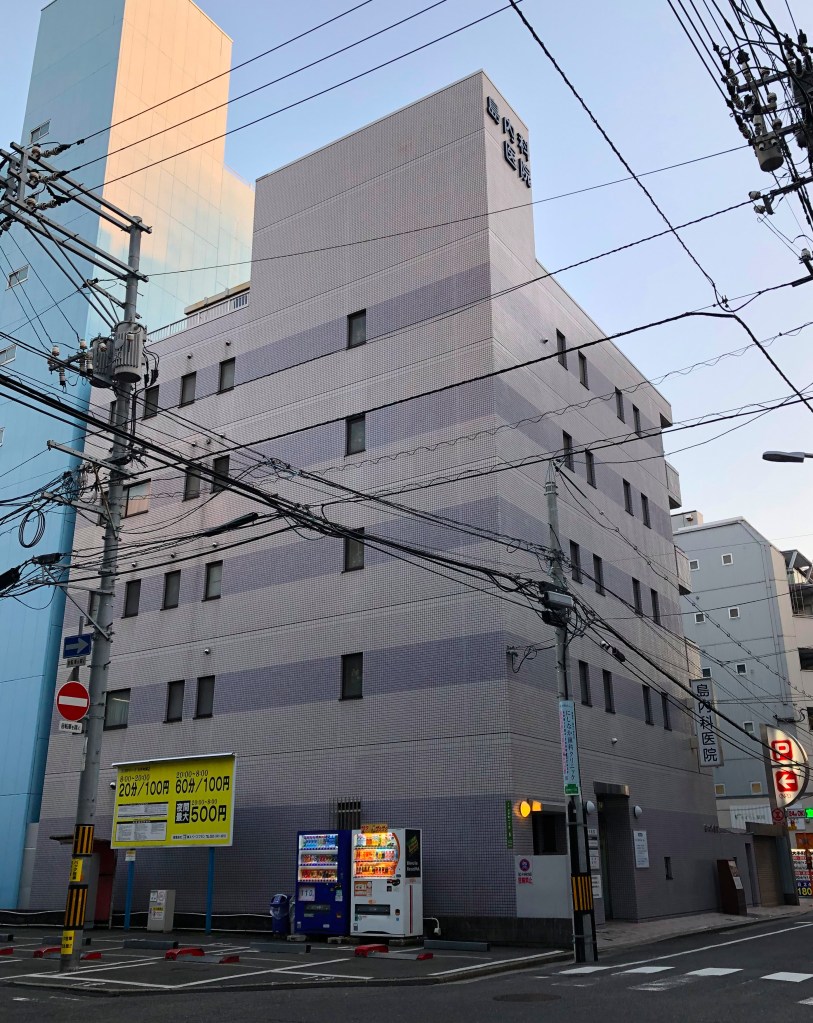
Shima clinic for internal medicine. About 600 meters above, the a-bomb exploded. This photo is taken by myself in February 2020.

The a-bomb exploded about 600 meters above[2.1] of the present (as of February 2020) Shima clinic for internal medicine which had been originally serving as Shima hospital since 1933[2.2].

3 days later from the bomb in Hiroshima, on 9 August, Fatman was dropped in Nagasaki[2.5].

Because of Little Boy in Hiroshima, it is estimated that about 140,000 people died until the end of 1945 according to Hiroshima city[3].

The atomic bomb’s tremendous energy comes from nuclear fission.

This image has an empty alt attribute; its file name is img_1726-e1581870644703.jpeg
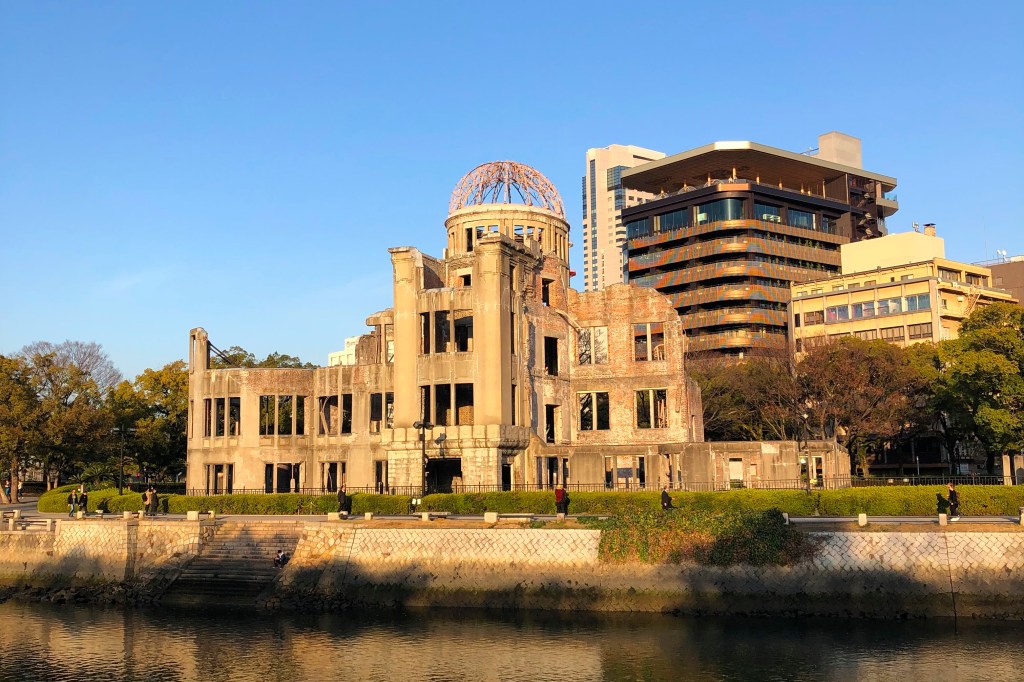
Hiroshima Peace Memorial, or the Atomic Bomb Dome (Genbaku Dome). This photo is taken by myself in February 2020.

Hiroshima Peace Memorial, or the Atomic Bomb Dome (Genbaku Dome)[3.5] was Hiroshima Prefectural Industrial Promotional Hall[3.6] which had been a building for local industry[4][4.5]. It was designed by Jan Letzel[5], architect who was “born in Náchod”[6] of “the present Czech Republic”[7]. He was asked by the then governor of Hiroshima prefecture Sukeyuki Terada in July 1913[8].

“In May 2016,”[9] Barack Obama, who was then in office as the 44th US president[10], visited Hiroshima.

The visit I went in February 2020 gave me opportunity to think about not just 1945 atomic bomb but also more broadly nuclear related issues. I think that preserving buildings and creating this sort of place to the world is important to convey history to people including the future generations. Because Hiroshima now preserves the history, I got an opportunity to look at the history after the visiting was planned, and I will try to think about more on these matters.

[0.5] Le Monde. Comment fonctionne une bombe atomique ? https://www.youtube.com/watch?v=9PARlF1tKfg Posted on 4 August 2017. Accessed 18 January 2020. Around 0:22-.

[0.6] CNN. Why the US dropped an atomic bomb on Hiroshima. Available at https://edition.cnn.com/2019/08/06/us/hiroshima-anniversary-explainer-trnd/index.html Last update on 6 August 2019. Accessed 13 February 2020.

[1] The City of Hiroshima. 原爆被害の概要. Available at http://www.city.hiroshima.lg.jp/www/contents/1111637106129/index.html Accessed 12 February 2020.

[1.1] The City of Hiroshima. 原爆被害の概要. http://www.city.hiroshima.lg.jp/www/contents/1111637106129/index.html Accessed 16 February 2020.

[2] WIRED. July 16, 1945: Trinity Blast Opens Atomic Age. https://www.wired.com/2008/07/dayintech-0716-2/ Published on 16 July 2008. Accessed 18 January 2020.

[2.1] Based on the description on a webpage of 島内科医院, available at http://www.shimagekanaika.jp/access.html Accessed 16 February 2020, an explanation in front of the clinic, visited in 2020, and the City of Hiroshima’s webpage 原爆被害の概要 available at http://www.city.hiroshima.lg.jp/www/contents/1111637106129/index.html accessed 16 February 2020.

[2.2] Based on the description on a webpage of Shima clinic for internal medicine, available at http://www.shimagekanaika.jp/access.html accessed 16 February 2020.

[2.5] CNN. Why the US dropped an atomic bomb on Hiroshima. Available at https://edition.cnn.com/2019/08/06/us/hiroshima-anniversary-explainer-trnd/index.html Last update on 6 August 2019. Accessed 13 February 2020.

[3] A Hiroshima city webpage in which the estimation of casualties is mentioned. Available at http://www.city.hiroshima.lg.jp/www/contents/1111638957650/index.html Accessed 12 February 2020.

[3.5] UNESCO. Hiroshima Peace Memorial (Genbaku Dome). Available at https://whc.unesco.org/en/list/775/ Accessed 13 February 2020. The website of and named Atomic Bomb Dome organised by Hiroshima city available at http://www.city.hiroshima.lg.jp/www/dome/genre/1001000050001/index.html Accessed 13 February 2020.

[3.6] The English translation of Hiroshimaken-sangyo-syourei-kan (広島県産業奨励館) as Hiroshima Prefectural Industrial Promotional Hall is based on the description on the website of UNESCO. Available at https://whc.unesco.org/en/list/775/. Accessed 13 February 2020.

[4] 頴原澄子. 原爆ドーム: 物産陳列館から広島平和記念碑へ. 吉川弘文館. ISBN978-4-642-05831-5. p.10. pp.48-50.

[4.5] The name of the building when constructed in 1915 was Hiroshimaken-bussan-chinretsukan (広島県物産陳列館) in Japanese, changed in [Source: p.10 of 頴原 澄子. 原爆ドーム: 物産陳列館から広島平和記念碑へ. 吉川弘文館. ISBN978-4-642-05831-5.]

[5] 頴原澄子. 原爆ドーム: 物産陳列館から広島平和記念碑へ. 吉川弘文館. ISBN978-4-642-05831-5. pp.36-38.

[6] Ibid. p.26.

[7] Ibid. p.26.

[8] Ibid. p.25, 36.

[9] CNN. Why the US dropped an atomic bomb on Hiroshima. Available at https://edition.cnn.com/2019/08/06/us/hiroshima-anniversary-explainer-trnd/index.html Last update on 6 August 2019. Accessed 13 February 2020.

[10] CNN. Why the US dropped an atomic bomb on Hiroshima. Available at https://edition.cnn.com/2019/08/06/us/hiroshima-anniversary-explainer-trnd/index.html Last update on 6 August 2019. Accessed 13 February 2020 and https://www.whitehouse.gov/about-the-white-house/presidents/barack-obama/ Accessed 14 February 2020.

Aichi triennale, withdrawal of the public fund

What I wrote this time is not consistent with the one published before as I have been thinking about related issues since the last publishing.

1. Withdrawal of the public fund

1. Withdrawal of the public fund

The fund had been adopted on 4 April[d]. The Agency for Cultural Affairs published the press release on 26 September that they do not provide the public funding with the Aichi Triennale 2019[a] — the fund was 78,290,000 yen[e], about 711,727 USD (1$=110JPY), about 652,417 EUR (1€=120JPY). This was “unprecedented”[i] that the decision which had been decided through the original process was withdrawn[j]. The decision was made “without consulting”[f] the members including Kunihiro Noda[g]. On 2 October[h], Kunihiro Noda, professor at Tottori University, left his position of the committee involved in deciding the adoption of the fund[c].

It became to public that there’s no minutes of the process of deciding to withdraw it[b].

I think that for many it looked like an ideological confrontation and I cannot deny that aspect. One of the tasks of the organizers is to create a space that the works are exhibited safely during the whole period as scheduled.

Society doesn’t become enriched at least in terms of culture if expression is restricted.

[a] The press release of the Agency for Cultural Affairs available at http://www.bunka.go.jp/koho_hodo_oshirase/hodohappyo/1421672.html Published 26 September 2019, Accessed 27 January 2020.

[b] https://twitter.com/motomura_nobuko/status/1178944070174904320 A tweet posted on 1 October 2019. Accessed 29 January 2020.

[c] jnpc. 「<表現の不自由展・その後>のその後」(2) 野田邦弘・鳥取大学教授 2019.10.24. https://www.youtube.com/watch?v=9LZRJr99v3c From the beginning to 1:23. Accessed 31 January 2020.

[d] Ibid. 17:44-18:18.

[e] Ibid. Around 21:17-21:28.

[f] Ibid. Around 22:07-22:12.

[g] Ibid. Around 22:07-22:12.

[h] Ibid. Around 22:39-22:52.

[i] Ibid. Around 25:20-25:32. This was on the slide and spoken.

[j] Ibid.

On time, redo

Upload: 23 February 2020, Last update: 5 April 2020

Would be better to aware that one cannot move to the past. One goes forward in one’s own life, One changes as surroundings change and cannot be the same as the moment which anyone imagine. Essentials may look like unchanged, but even if it seems so, the it’s not completely the same as before since some are added to oneself.

Time proceeds without stopping. When one made a mistake, and wants to redo it isn’t redo in a sense that time has passed. Redo isn’t actually redo of the time it should have been succeeded.

Doing close to the first time is difficult.

Because time is limited, what are achieved have value.