[2/4] Structure of politics — (direct-democracy, indirect-democracy, referendum, deliberation)

The previous chapter “[1/4] Structure of politics — (direct-democracy, indirect-democracy, referendum, deliberation)

2. Decentralization

2.1. Technology and direct democracy

3. US presidential election in 2016 and French one in 2017

2. Decentralization

The transition of the world from “Before the Internet (BI)” to “After the Internet (AI)”[1] brought benefits, but with regard to the flow of information, human beings are affected negatively as well. However, I do believe that we can have better political structure inclusively works to make society for everyone. As a way to establish the political system, I focus on the notion decentralization to distribute powers from center to edge so that we can prevent abuse of power or corruption among those who in power. As decentralization (in political sense) enables citizens to have further accessibility to join in — in this respect I wonder if I might be able to say the universal suffrage is one of the cases since before that happened people didn’t have right (or power) to choose which means that was enclosed in those in power,  decentralization prevents excessive concentration of power in a few authorities — after the emergence of the Internet the power balance between center and edge became relatively smaller to some extent. People speak up by gathering together on the Internet and move on to making movement, and there are many cases that it had impact on our world. Because of this sort of phenomenon, society would be more inclusive, less people left behind. Decentralization is related to direct democracy in a meaning that people have a way to express their collective voice to authority.

2.1. Technology and direct democracy

An idea to implement system of direct democracy is worth discussing, as in technologically developed society we can almost simultaneously catch up with what is going on, for example in where decision is being made or in our life basis we can be updated everyday. People can take various actions such as raising question, giving critical comment, launching movement.  Given the concerns I mentioned, direct democracy is too early at this moment — suppose in the future people might be able to deal with vast amount of information in daily life which may be idealistic, another possibility is that as the current world has the tendency that people are divided into the different fields depending on interest of each, our future world might be divided more, less people are interested in politics — , but expecting the (near) future in which we would be able to install by our capacity or even now and more for the future because of technological advancement there’s need to at least think about whether direct-democracy works or not, I take a look at it this time.

3. US presidential election in 2016 and French one in 2017

Concern on democracy derived from politics of the latter half of 2010s. Democracy has been always on the table of discussion as it’s been discussed especially using terms like crisis, defect, problem, and other negative aspects of democracy, so improving democracy (or political system) is a shared sense among us — it depends on persons how much they feel the current system is not working well though. We are more and more moving into crucial phase, so do democracies, as we have seen the current political trend around the 2016 US presidential election in which Donald Trump was elected, and the 2017 French presidential election in which Emmanuel Macron won, Marine Le Pen showed her strong influence. As for the French case, based on the report of Le Monde[1.5], the result of first round was: Emmanuel Macron (24.01%), Marine Le Pen (21.30%), François Fillon (20.01%), Jean-Luc Melenchon (19.58%), Benoît Hamon (6.36%), Nicolas Dupont-Aignan (4.70%), Jean Lassalle (1.21%), Philippe Poutou (1.09%), François Asselineau (0.92%), Nathalie Arthaud (0.64%), and Jacques Cheminade (0.18%). Since Marine Le Pen who is regarded as far-right showed popularity, on 23 April 2017, François Fillon from The Republicans clearly said that he supports Macron[1.6] and, as Levitsky, S. & Ziblatt, D. (2019). How Democracies Die explains, “called his partisans to vote for center-left candidate Emmanuel Macron to keep far-right candidate Marin Le Pen out of power”[2], although François Fillon is “right-wing”[3], he asked support for Macron to prevent an extremist from taking office. In the second round, citing the analysis of Financial Times[4], Levitsky and Ziblatt explained that about “half of François Fillon’s conservative Republican party voters followed his surprising endorsement of Macron; about another third abstained, leaving around a sixth of Fillon’s supporters who went for Le Pen, arguably making a key difference in that country’s election”[5]. For US case, it analyzed about the presidency of Donald Trump, using “the Four Key Indicators of Authoritarian Behavior” — “1. Rejection of (or weak commitment to) democratic rules of the game”, “2. Denial of the legitimacy of political opponents”, “3. Toleration or encouragement of violence”, and “4. Readiness to curtail civil liberties of opponents, including media”[6]. While referring examples to the criteria, Donald Trump is applied to all of these indicators[7]. These two cases indicate that in the current politics, politician with extreme political ideology can (almost in the case of Le Pen) reach to the very center of politics supported by citizens. If we continue to see this sort of influence that extremists can have, the concerns over more democratic political system would be piled up.

[1] The words “BI (Before the Internet)” and “AI (After the Internet)” come from Joi Ito. For example, he described this way in his TED talk titled Seeing the Future: Joi Ito at TEDxMidwest available at https://www.youtube.com/watch?v=LN6Vn-aqgFs 1:08-Accessed 3 December 2019.

[1.5] Le Monde. Présidentielle 2017. Available at https://www.lemonde.fr/data/france/presidentielle-2017/ Accessed 3 February 2020.

[1.6] Fillon spoke of it on 23 April 2017, as for this a report from Reuter available at https://www.reuters.com/article/us-france-election-fillon-idUSKBN17P0T0 Accessed 28 November 2019, a video posted by Bloomberg Politics available at https://www.youtube.com/watch?v=vRWcwmJhXm8 Accessed 28 November 2019.

[2] Levitsky, S. & Ziblatt, D. (2019). How Democracies Die. Published in Penguin Books. Originally published by Crown in 2018. p.68. 

[3] Ibid.

[4] Financial Times. French election results: Macron’s victory in charts.  https://www.ft.com/content/62d782d6-31a7-11e7-9555-23ef563ecf9a Published 9 May 2020. Accessed 20 March 2020.

[5] Ibid. p.70. 

[6] Ibid. p.61-67.

[7] Ibid. His actual remarks are cited in the book in detail.

[1/4] Structure of politics — (direct-democracy, indirect-democracy, referendum, deliberation)

This series of text is written to picture political structure, or more broadly social structure. It hasn’t been written enough yet, and will be added further or modified in the future.

  1. Concerns over direct democracy
  1. Concerns over direct democracy

As we have been moving to more democratized politics along with the development of technology, there is voice that hopes to move to direct democracy. Even if we look at democracies in the modern world, indirect-democracy, in which a certain number of people is chosen in election and becomes representatives of citizens, doesn’t reflect public opinion precisely and straightforwardly. In this respect, direct democracy allows citizens to have more chance in decision-making in politics and presumably direct democracy could reflect the public opinion more precisely — this doesn’t mean that I completely agree with direct democracy because even if a large number of people have a same opinion and hypothetically it leads to an actual action of the state, it is not necessarily a right choice, not necessarily a proper choice that means the possible outcomes the decision would cause are not necessarily taken into account adequately given the complicatedness of the current politics. This time, as for reflecting public opinion in politics more directly, I take a look at the Switzerland’s referendums and the case of France in which citizens’ initiative referendum was claimed among the demonstrators in the Yellow vest movement. 

Before beginning to step into it, first I do emphasize the concerns over direct democracy. Generally saying, the world has been getting increasingly to the direction of improving democracy. I don’t think this trend is wrong and I’m not saying that I’m against democracy. But the emergence of the Internet, particularly social media, made possible the traffic of huge amount of information which, I presume,  people cannot deal with at least as of right now. That changed the world. Opinions and claims on the Internet can be powerful by being shared by its users — I understand this has positive aspects which made possible the movements such as Me Too uniting those who are willing to change society in better way, however in the meantime it allows to spread negative information such as fake news which include those posted to deceive Internet users on purpose and others which didn’t intend to, but incidentally caused by lack of understanding on the matters. Much importantly, the media literacy hasn’t developed enough among the public to live in highly rapid-informational life. This is a reason many people are stirred up on social media. In order to digest huge amount of information, we unconsciously need to do comprehensive understanding what the essential(s) of each topic is(are), how much important it is, and whether it’s worth sharing or adding comment to. Even though there are those who publicize posts stirring up others at this moment, if they are more with rational way of thinking they would not find out value in heckling. This way of thinking is not always consciously carried out, I think that if we are with more critical capabilities which presumably could be focused in compulsory education by having philosophical and critical class, we would be able to unconsciously be better at media literacy and might be able to process vast amount of information. The internet enabled citizens to come across enormous volume of information in daily life. I have an impression that people tend to focus just on small pieces of information trending then and when the next one comes up, they jump on it. They quite emotionally move on to new pieces. People tend to be quite easily swung by comments and pieces of news provoking them. In order to have politics proceed in more logically and rationally — this doesn’t mean excluding or eliminating some people, we need to comprehensively understand politics or whatever matters we have from broader viewpoint. Also, the dramatical increase of superficial information can be dealt with by thinking essentially. Even if superficially increased, the cores are the almost same. This is a reason why I emphasize the importance of being capable of comprehensively understanding. In addition to the descriptions above, I think the problem that feelings are more powerful than facts in the current world has to do with the weakness or loss of what Jacques Lacan explained in his theory.

BBC, License fee, polarized politics

As politics is polarized and more fragmented, BBC faces difficulty.

And now they face changes.

Tony Hall will leave the position of director general at BBC “in summer”[1].

Also, BBC News announced they will cut 450 jobs in the near future[2].

In the polarized world, the way that a news organization raise fund by collecting license fee from the public isn’t applicable. The role of media as watchdog should be kept in society, but the divided society causes harsher backlash or hostility in the case like the current politics in UK.

[1] The Guardian. Tony Hall to step down as BBC director general. https://www.theguardian.com/media/2020/jan/20/tony-hall-to-step-down-as-bbc-director-general Uploaded 20 January 2020. Accessed 29 February 2020.

[2] BBC. BBC News to close 450 posts as part of £80m savings drive. https://www.bbc.com/news/entertainment-arts-51271168 Uploaded 29 January 2020. Accessed 7 March 2020.

Hiroshima, the atomic bomb

Upload: 28 February 2020, Last update: 29 February 2020

Atomic bomb “Little Boy”[0.5] was dropped by B29 Enola Gay in Hiroshima[0.6] “at 8:15 am on 6 August” 1945[1] — “43 seconds later”[1.1] exploded — after the Trinity test succeeded on 16 July the same year[2].

This image has an empty alt attribute; its file name is img_1800-e1581868124837.jpeg
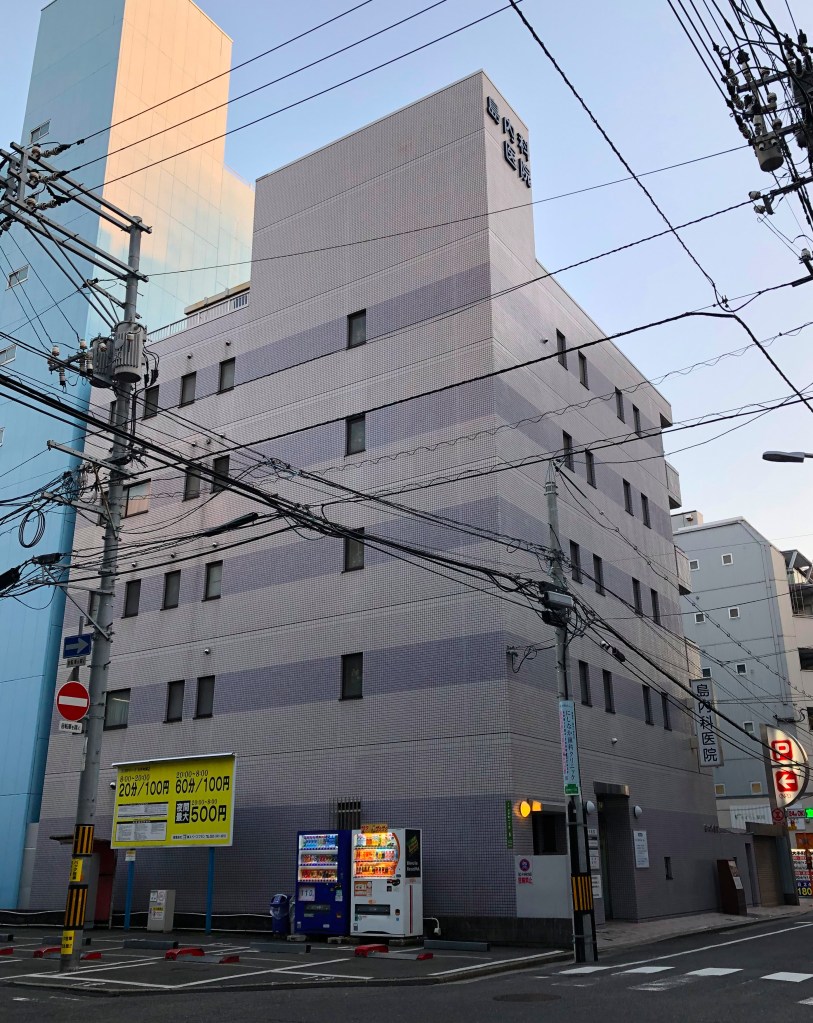
Shima clinic for internal medicine. About 600 meters above, the a-bomb exploded. This photo is taken by myself in February 2020.

The a-bomb exploded about 600 meters above[2.1] of the present (as of February 2020) Shima clinic for internal medicine which had been originally serving as Shima hospital since 1933[2.2].

3 days later from the bomb in Hiroshima, on 9 August, Fatman was dropped in Nagasaki[2.5].

Because of Little Boy in Hiroshima, it is estimated that about 140,000 people died until the end of 1945 according to Hiroshima city[3].

The atomic bomb’s tremendous energy comes from nuclear fission.

This image has an empty alt attribute; its file name is img_1726-e1581870644703.jpeg
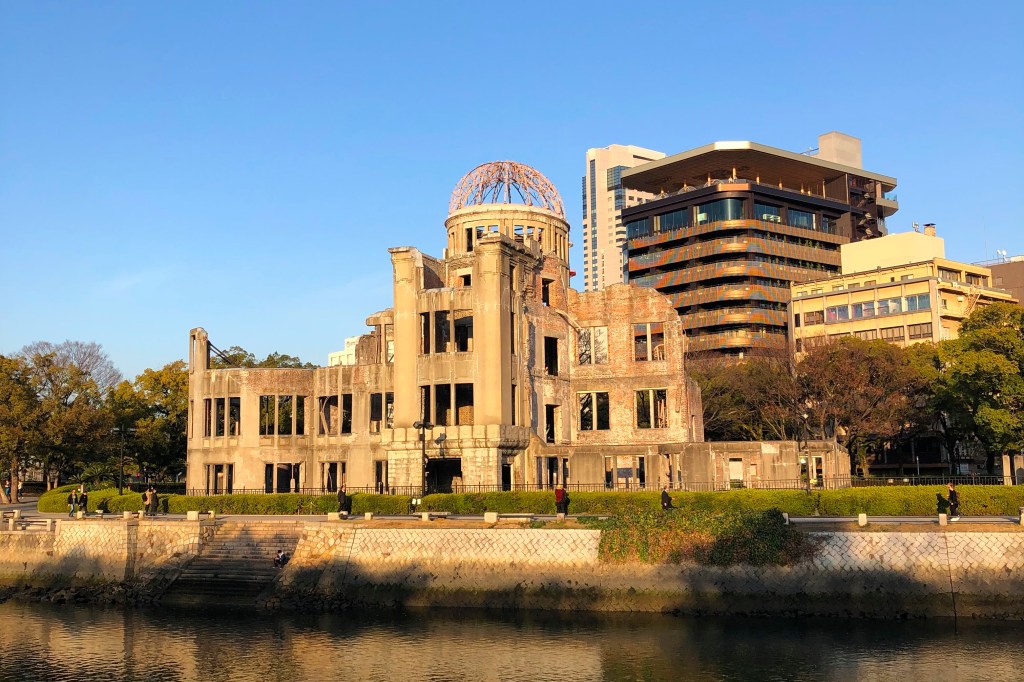
Hiroshima Peace Memorial, or the Atomic Bomb Dome (Genbaku Dome). This photo is taken by myself in February 2020.

Hiroshima Peace Memorial, or the Atomic Bomb Dome (Genbaku Dome)[3.5] was Hiroshima Prefectural Industrial Promotional Hall[3.6] which had been a building for local industry[4][4.5]. It was designed by Jan Letzel[5], architect who was “born in Náchod”[6] of “the present Czech Republic”[7]. He was asked by the then governor of Hiroshima prefecture Sukeyuki Terada in July 1913[8].

“In May 2016,”[9] Barack Obama, who was then in office as the 44th US president[10], visited Hiroshima.

The visit I went in February 2020 gave me opportunity to think about not just 1945 atomic bomb but also more broadly nuclear related issues. I think that preserving buildings and creating this sort of place to the world is important to convey history to people including the future generations. Because Hiroshima now preserves the history, I got an opportunity to look at the history after the visiting was planned, and I will try to think about more on these matters.

[0.5] Le Monde. Comment fonctionne une bombe atomique ? https://www.youtube.com/watch?v=9PARlF1tKfg Posted on 4 August 2017. Accessed 18 January 2020. Around 0:22-.

[0.6] CNN. Why the US dropped an atomic bomb on Hiroshima. Available at https://edition.cnn.com/2019/08/06/us/hiroshima-anniversary-explainer-trnd/index.html Last update on 6 August 2019. Accessed 13 February 2020.

[1] The City of Hiroshima. 原爆被害の概要. Available at http://www.city.hiroshima.lg.jp/www/contents/1111637106129/index.html Accessed 12 February 2020.

[1.1] The City of Hiroshima. 原爆被害の概要. http://www.city.hiroshima.lg.jp/www/contents/1111637106129/index.html Accessed 16 February 2020.

[2] WIRED. July 16, 1945: Trinity Blast Opens Atomic Age. https://www.wired.com/2008/07/dayintech-0716-2/ Published on 16 July 2008. Accessed 18 January 2020.

[2.1] Based on the description on a webpage of 島内科医院, available at http://www.shimagekanaika.jp/access.html Accessed 16 February 2020, an explanation in front of the clinic, visited in 2020, and the City of Hiroshima’s webpage 原爆被害の概要 available at http://www.city.hiroshima.lg.jp/www/contents/1111637106129/index.html accessed 16 February 2020.

[2.2] Based on the description on a webpage of Shima clinic for internal medicine, available at http://www.shimagekanaika.jp/access.html accessed 16 February 2020.

[2.5] CNN. Why the US dropped an atomic bomb on Hiroshima. Available at https://edition.cnn.com/2019/08/06/us/hiroshima-anniversary-explainer-trnd/index.html Last update on 6 August 2019. Accessed 13 February 2020.

[3] A Hiroshima city webpage in which the estimation of casualties is mentioned. Available at http://www.city.hiroshima.lg.jp/www/contents/1111638957650/index.html Accessed 12 February 2020.

[3.5] UNESCO. Hiroshima Peace Memorial (Genbaku Dome). Available at https://whc.unesco.org/en/list/775/ Accessed 13 February 2020. The website of and named Atomic Bomb Dome organised by Hiroshima city available at http://www.city.hiroshima.lg.jp/www/dome/genre/1001000050001/index.html Accessed 13 February 2020.

[3.6] The English translation of Hiroshimaken-sangyo-syourei-kan (広島県産業奨励館) as Hiroshima Prefectural Industrial Promotional Hall is based on the description on the website of UNESCO. Available at https://whc.unesco.org/en/list/775/. Accessed 13 February 2020.

[4] 頴原澄子. 原爆ドーム: 物産陳列館から広島平和記念碑へ. 吉川弘文館. ISBN978-4-642-05831-5. p.10. pp.48-50.

[4.5] The name of the building when constructed in 1915 was Hiroshimaken-bussan-chinretsukan (広島県物産陳列館) in Japanese, changed in [Source: p.10 of 頴原 澄子. 原爆ドーム: 物産陳列館から広島平和記念碑へ. 吉川弘文館. ISBN978-4-642-05831-5.]

[5] 頴原澄子. 原爆ドーム: 物産陳列館から広島平和記念碑へ. 吉川弘文館. ISBN978-4-642-05831-5. pp.36-38.

[6] Ibid. p.26.

[7] Ibid. p.26.

[8] Ibid. p.25, 36.

[9] CNN. Why the US dropped an atomic bomb on Hiroshima. Available at https://edition.cnn.com/2019/08/06/us/hiroshima-anniversary-explainer-trnd/index.html Last update on 6 August 2019. Accessed 13 February 2020.

[10] CNN. Why the US dropped an atomic bomb on Hiroshima. Available at https://edition.cnn.com/2019/08/06/us/hiroshima-anniversary-explainer-trnd/index.html Last update on 6 August 2019. Accessed 13 February 2020 and https://www.whitehouse.gov/about-the-white-house/presidents/barack-obama/ Accessed 14 February 2020.

Aichi triennale, withdrawal of the public fund

What I wrote this time is not consistent with the one published before as I have been thinking about related issues since the last publishing.

1. Withdrawal of the public fund

1. Withdrawal of the public fund

The fund had been adopted on 4 April[d]. The Agency for Cultural Affairs published the press release on 26 September that they do not provide the public funding with the Aichi Triennale 2019[a] — the fund was 78,290,000 yen[e], about 711,727 USD (1$=110JPY), about 652,417 EUR (1€=120JPY). This was “unprecedented”[i] that the decision which had been decided through the original process was withdrawn[j]. The decision was made “without consulting”[f] the members including Kunihiro Noda[g]. On 2 October[h], Kunihiro Noda, professor at Tottori University, left his position of the committee involved in deciding the adoption of the fund[c].

It became to public that there’s no minutes of the process of deciding to withdraw it[b].

I think that for many it looked like an ideological confrontation and I cannot deny that aspect. One of the tasks of the organizers is to create a space that the works are exhibited safely during the whole period as scheduled.

Society doesn’t become enriched at least in terms of culture if expression is restricted.

[a] The press release of the Agency for Cultural Affairs available at http://www.bunka.go.jp/koho_hodo_oshirase/hodohappyo/1421672.html Published 26 September 2019, Accessed 27 January 2020.

[b] https://twitter.com/motomura_nobuko/status/1178944070174904320 A tweet posted on 1 October 2019. Accessed 29 January 2020.

[c] jnpc. 「<表現の不自由展・その後>のその後」(2) 野田邦弘・鳥取大学教授 2019.10.24. https://www.youtube.com/watch?v=9LZRJr99v3c From the beginning to 1:23. Accessed 31 January 2020.

[d] Ibid. 17:44-18:18.

[e] Ibid. Around 21:17-21:28.

[f] Ibid. Around 22:07-22:12.

[g] Ibid. Around 22:07-22:12.

[h] Ibid. Around 22:39-22:52.

[i] Ibid. Around 25:20-25:32. This was on the slide and spoken.

[j] Ibid.